




Info
Once, Zhuang Zhou dreamed that he was a butterfly, a butterfly flitting and fluttering about, happy with himself and doing as he pleased. He didn’t know that he was Zhuang Zhou.
Suddenly he woke up and there he was, solid and unmistakable Zhuang Zhou.
But he didn’t know if he was Zhuang Zhou who had dreamt he was a butterfly, or a butterfly dreaming he was Zhuang Zhou. Between Zhuang Zhou and the butterfly there must be some distinction! This is called the Transformation of Things.
(Zhuang Zhou, filosofo cinese, ca. 369-286 aC)
Our reflection on sleep begins with the famous dream paradox of Zhuang Zhou (369–286 BCE), who imagines dreaming that he is a butterfly and, upon awakening, can no longer tell whether it was Zhuang Zhou who dreamed of being a butterfly or a butterfly who dreamed of being Zhuang Zhou.
In this brief tale, dreaming already appears as a threshold where identity, perception, and reality continuously transform one another. Far from being mere escapism, the dream is an experience in which what we see, remember, or imagine loses its boundaries and can no longer be clearly distinguished.
Dreams inhabit sleep, a fundamental biological, physical, and psychological process in which the suspension of consciousness should lead to rest and regeneration. Without sleep, there is no life. Yet for many, sleep remains elusive: the mind cannot surrender, the body cannot recover, and rest becomes a source of unease and exhaustion.
Dreams themselves are never unambiguous. They may hold memories and projections of desire, but they can equally become a space for fear, distortion, and confrontation with what exceeds our control, assuming unsettling and obscure forms.
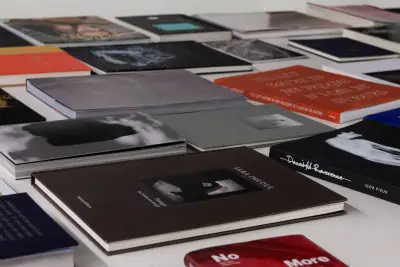
It is within this oscillation between rest and disturbance that the books gathered in this selection find their place. Their images evoke sleep and dreams through fractured realities, subtle displacements, and suspended atmospheres: landscapes become mental spaces, documents become visions, memory turns into spectre and hallucination, while the body itself undergoes metamorphosis.
The books on display invite us to consider sleep and dreams as tools for questioning our experience of the world, the porous nature of consciousness, the vulnerability of the body, the persistence of desire, and the enduring possibility of imagining otherwise.
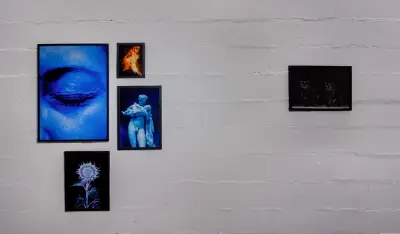
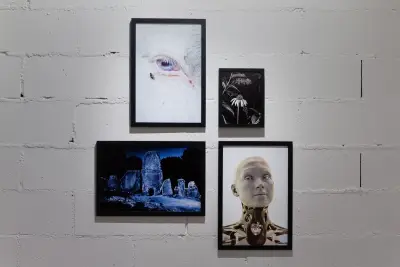
Alongside this selection of photobooks, REM by Gian Marco Sanna introduces a distinctly contemporary dimension: a nocturnal imagination disrupted by technology. Here, the dream is no longer simply the free territory of the psyche, but an altered landscape invaded by the glow of screens, where the unconscious, entangled with the interferences of the present, can only project itself as nightmare.
In a world saturated with screens, devices, and constant connectivity, the night is no longer clearly separated from the day. Artificial light and continuous visual overstimulation have profoundly altered our sleep–wake cycles. Sleep and dreams no longer offer a temporary escape from the world; instead, the world itself infiltrates them, leaving behind its traces and residues.